Subsurface Hydrogen Battery
{SHB}
By Eugene Allen
The Subsurface Hydrogen Battery (SHB) is a breakthrough in clean energy storage — a system designed to safely and affordably store renewable energy at scale by turning excess electricity into hydrogen and placing it securely underground. Unlike conventional batteries or traditional hydrogen tanks, the SHB eliminates the need for high-pressure vessels, rare minerals, or complex above-ground facilities. Instead, it relies on a “drill-and-drop” approach, where modular hydrogen cylinders are lowered into boreholes and sealed beneath the earth.
This design is as simple as it is powerful. Energy generated from solar, wind, or hydro is used to split water into hydrogen and oxygen. The hydrogen is stored in sealed underground containers surrounded by a charcoal buffer layer — a natural stabilizer that absorbs excess gas, prevents leakage, and ensures safety. When energy is needed, the hydrogen is retrieved and converted back into electricity on demand, providing reliable power day or night.
What makes the SHB different from every storage solution before it is its scalability and flexibility. It can serve a single off-grid home, a rural community, or even a national grid. Its modular design allows containers to be swapped or maintained without disturbing the borehole. Safety is guaranteed through layered protections: AI flow sensors, dual-stage regulators, and a passive emergency dispersal system that prevents explosion risk even in worst-case scenarios.
The SHB isn’t just a battery — it’s a complete energy framework. From hydrogen production (via a next-generation electrolysis cartridge called the Electroid) to underground storage and efficient re-conversion into electricity, every component has been engineered for low-cost maintenance, longevity, and sustainability. No rare metals. No fragile supply chains. No billion-dollar plants. Just water, renewable energy, and the ground beneath our feet.
With this system, communities no longer have to depend on centralized grids or imported fuels. A village, a city, or an entire island nation can build energy independence by producing and storing power locally — and even generating fresh water as a byproduct of hydrogen combustion.
SHB
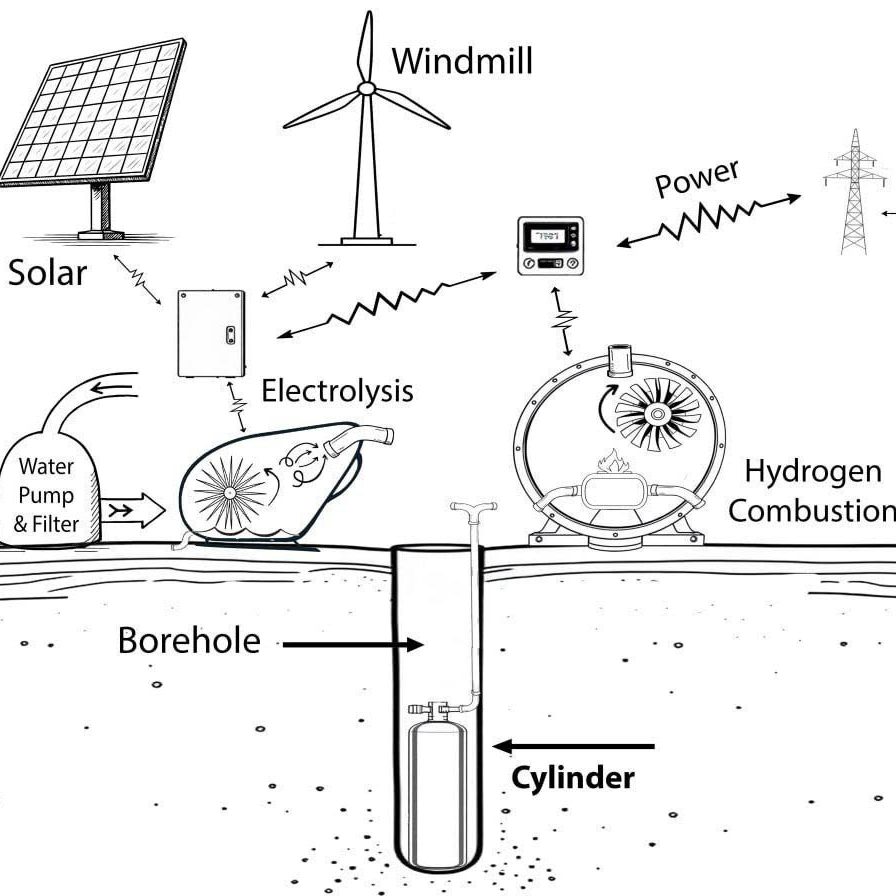
This diagram illustrates the simple but powerful cycle of the Subsurface Hydrogen Battery. The process begins with renewable energy generation — solar panels and wind turbines capture clean energy from the environment. This electricity is routed into an electrolysis system, which uses the power to split filtered water into hydrogen and oxygen.
Once produced, the hydrogen is directed into cylinders lowered into underground boreholes. This subsurface method allows energy to be stored in a compact, safe, and scalable way, eliminating the challenges of above-ground hydrogen storage. The cylinders act as modular “energy cells,” each capable of being added or replaced as community demand grows.
When the grid requires power, the stored hydrogen is fed back into a combustion unit, where it burns cleanly to generate electricity. The only byproduct of this process is water vapor, meaning no pollution, no carbon emissions, and even the possibility of reclaiming fresh water for use. The electricity is then transmitted directly to homes, businesses, and cities, providing 24/7 renewable power even when the sun isn’t shining or the wind isn’t blowing.
The Distributed Borehole Network
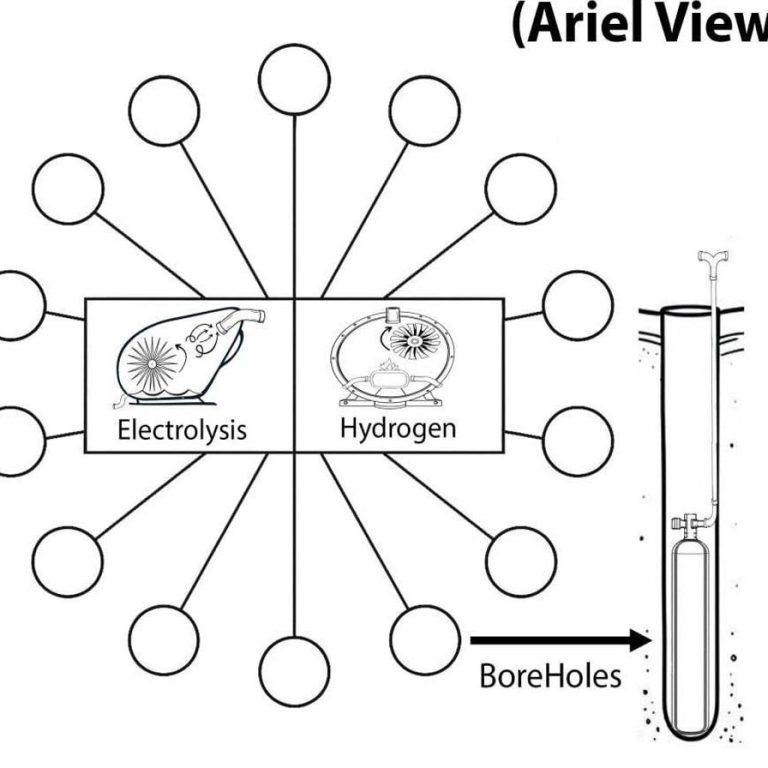
This schematic illustrates how the Subsurface Hydrogen Battery can scale into a distributed network of underground storage units. Each circle in the diagram represents a borehole containing a hydrogen storage cylinder. During the day, hydrogen produced through electrolysis is funneled into these boreholes, where it is safely stored under pressure. At night, or during peak demand, the stored hydrogen is retrieved and converted back into clean electricity.
The strength of this system lies in its modularity. Unlike centralized storage facilities that require massive infrastructure, the Subsurface Hydrogen Battery grows organically with demand. New boreholes can be added incrementally, creating a flexible, expandable network that adapts to the needs of each community or utility. This ensures not only scalability but also redundancy: if one borehole needs servicing, the others continue to operate without interruption.
Maintenance is streamlined by the removable cylinder design. Each hydrogen cylinder can be lifted out for inspection, repair, or replacement without disrupting the rest of the network. This minimizes downtime and keeps operational costs low. As communities expand, more boreholes can simply be drilled and connected, creating a living, resilient energy storage system capable of powering neighborhoods, cities, and eventually entire regions.
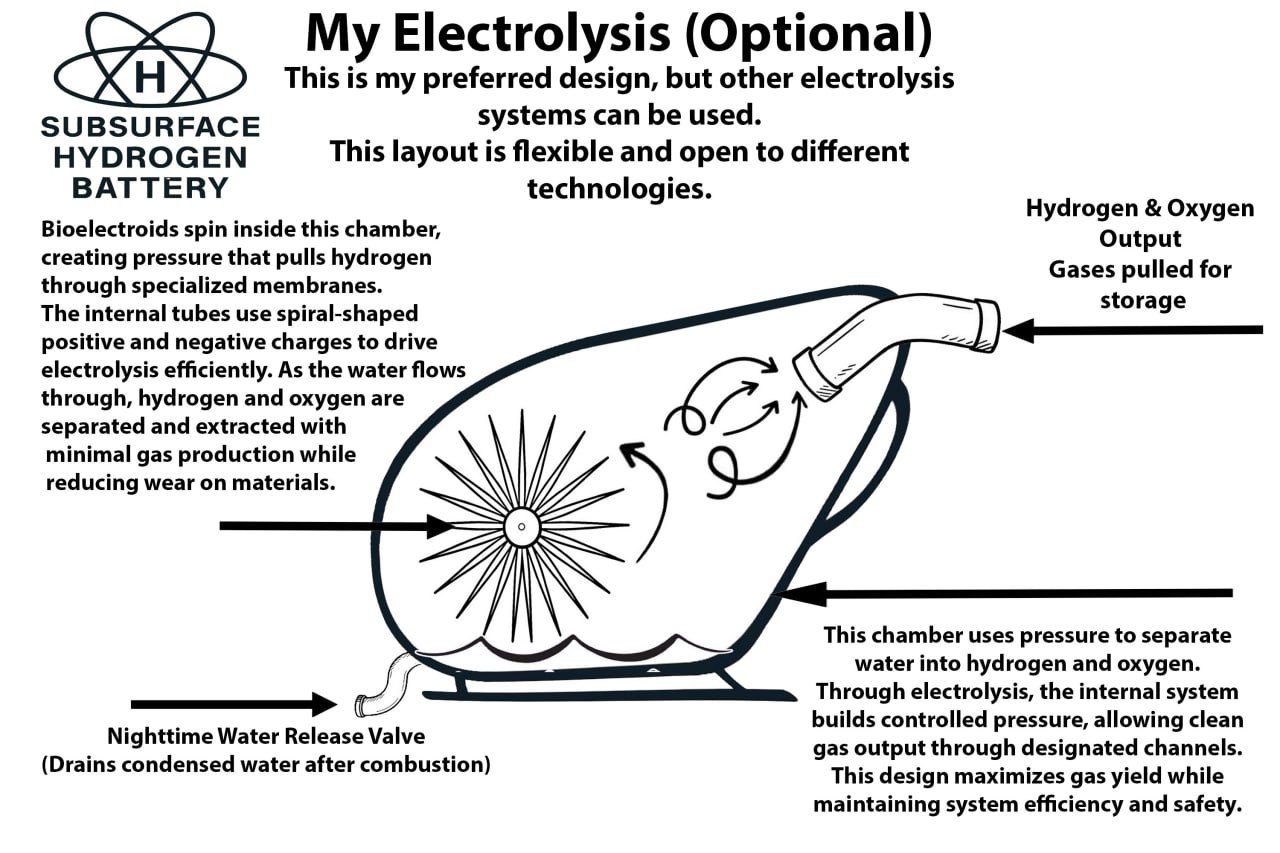
Bioelectroids:
A New Class of Energy Interface
Traditional electrodes in electrolysis are made from industrial metals or synthetic compounds that degrade over time, leach materials into the system, and demand costly replacement. What I’ve created are bioelectroids — a new class of electrode that integrates natural design principles with advanced conductive materials to deliver stability, efficiency, and sustainability.
Bioelectroids work by mimicking biological systems. In the same way that nerves transmit signals through bioelectric gradients, these electrodes harness micro-structured geometries and field alignment to maximize surface interaction with water molecules. This design dramatically improves hydrogen and oxygen separation while reducing the energy wasted in heat, friction, and material wear. The result is higher efficiency at lower input costs.
Unlike conventional electrodes, bioelectroids are designed to be self-stabilizing and durable, capable of operating under high stress without rapid breakdown. Because they are inspired by natural electrical pathways, they are less prone to fouling and can even be manufactured from more sustainable materials. This means lower long-term costs, easier scaling, and the ability to integrate into a wide range of electrolysis systems.
In short, bioelectroids are not just an upgrade to electrodes — they represent an entirely new generation of energy interface technology. They are central to the Subsurface Hydrogen Battery because they make electrolysis more practical, more scalable, and more environmentally aligned than anything before it.
SHB
Hydrogen Combustion:
Clean Power and Water Recovery
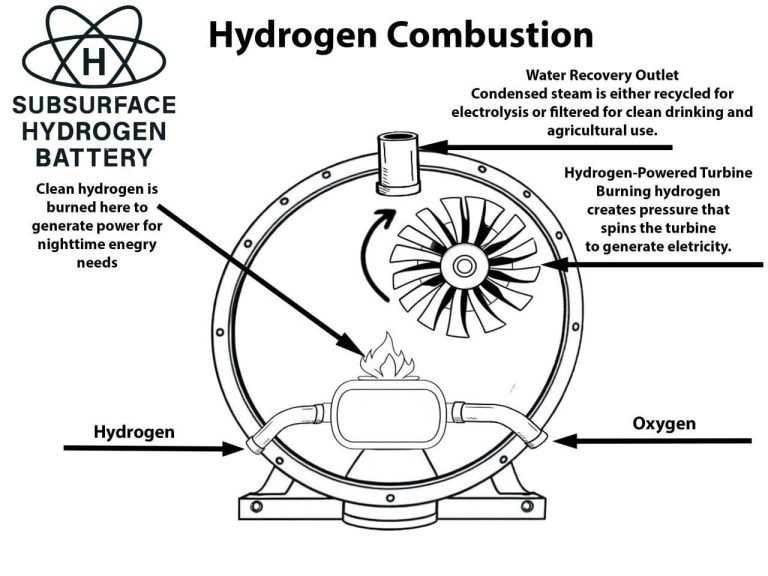
At the heart of the Subsurface Hydrogen Battery is its hydrogen combustion unit, designed to deliver reliable, renewable power during periods when solar and wind energy are unavailable. Stored hydrogen is drawn up from the subsurface cylinders and combined with oxygen in a controlled chamber. When ignited, this reaction produces a powerful burst of energy that spins a high-efficiency turbine, converting clean combustion into electricity for nighttime and peak energy demands.
A key advantage of this process is that the only byproduct is water. As the hydrogen burns, steam is created, which is then condensed through the system’s water recovery outlet. This water can either be recycled directly back into the electrolysis process—creating a closed-loop renewable cycle—or filtered for safe drinking water and agricultural use. By transforming energy storage into both clean power and usable water, the system provides communities with multiple layers of value.
This design ensures zero harmful emissions, making it one of the cleanest and most sustainable energy systems available. Unlike fossil fuel combustion, which releases carbon dioxide and other pollutants, hydrogen combustion is completely carbon-free. The combination of power generation, water recovery, and sustainability makes this stage of the system central to fulfilling the promise of 24/7 clean, renewable energy.
Borehole Design
Safe and Secure Underground Hydrogen Storage
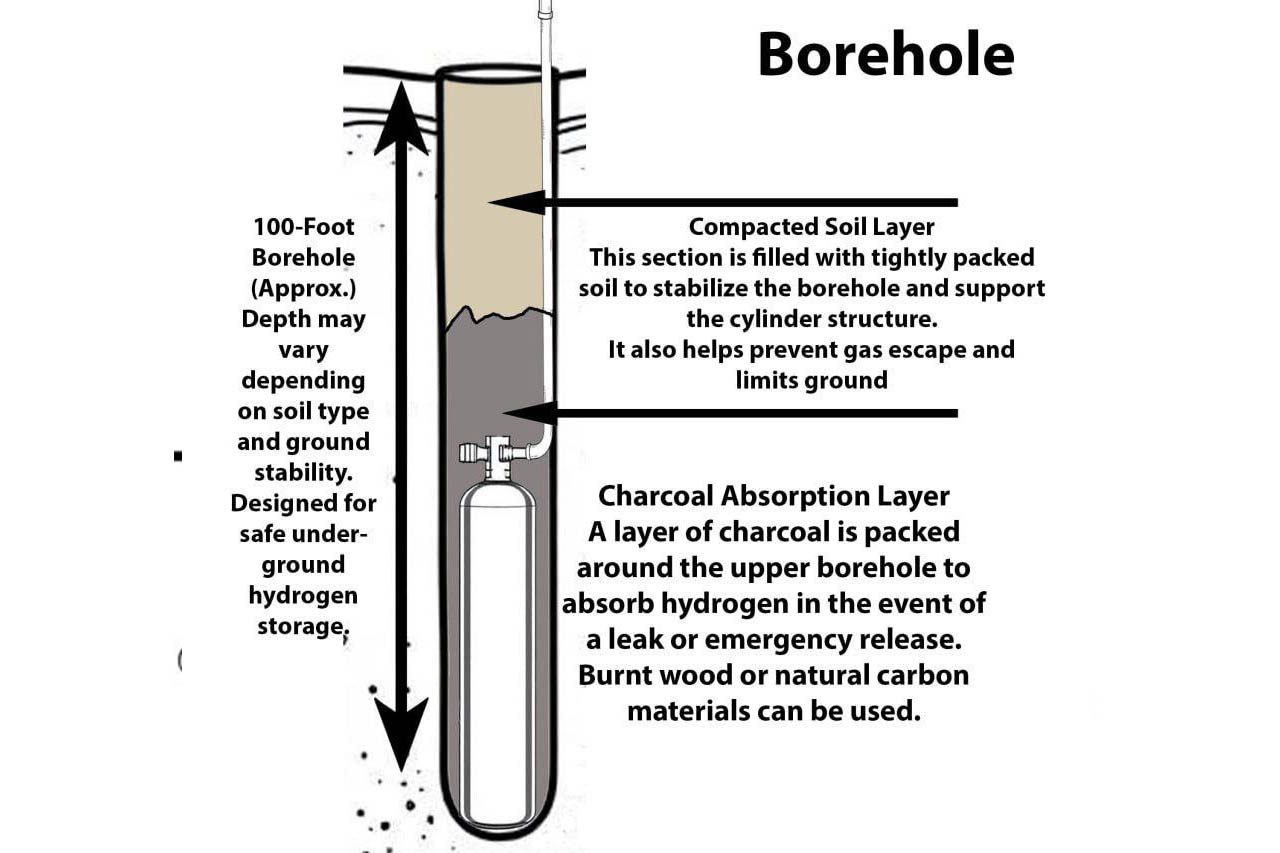
The borehole is the backbone of the Subsurface Hydrogen Battery system, engineered to provide safe, stable, and long-term underground storage for hydrogen. Each borehole extends roughly 100 feet below the surface, though depth can be adjusted depending on soil type and ground stability. By placing the cylinders deep underground, the system takes advantage of natural insulation, protection from environmental hazards, and additional safety against surface-level risks.
To reinforce stability, the upper sections of the borehole are compacted with tightly packed soil. This layer not only supports the structure of the borehole but also minimizes the chance of gas escape, ensuring secure containment of the hydrogen storage cylinders. Safety is further enhanced by a charcoal absorption layer placed near the upper borehole. This layer, composed of natural carbon materials such as burnt wood, acts as a safeguard by absorbing any hydrogen that might escape in the rare event of a leak or emergency release.
Together, these design elements create a multi-layered safety system that combines engineering precision with natural materials. The result is a storage solution that is robust, environmentally friendly, and easily maintainable, ensuring that hydrogen can be stored underground with confidence while maintaining community safety and system reliability.
Cylinder Design: Durable, Safe, and Built for Longevity
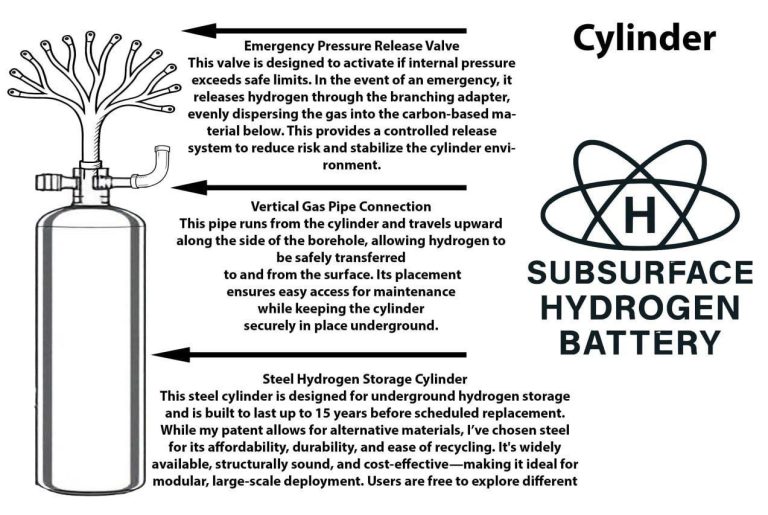
At the heart of the Subsurface Hydrogen Battery system is the steel hydrogen storage cylinder, engineered to withstand underground conditions and provide reliable long-term storage. Each cylinder is designed for durability, with an expected lifespan of up to 15 years before scheduled replacement. Steel was selected as the primary material for its affordability, strength, recyclability, and widespread availability. This makes it not only cost-effective but also practical for modular, large-scale deployment. While alternative materials may be explored in the future, steel offers a robust foundation for immediate implementation.
The cylinder connects to the surface through a vertical gas pipe system, which allows hydrogen to be safely transferred in and out of the borehole. This vertical pipeline is designed for both efficiency and maintenance accessibility, ensuring that the cylinders remain secure underground while still being easy to service when needed. The design prioritizes both safety and usability, making routine maintenance straightforward without compromising structural integrity.
For additional safety, each cylinder is fitted with an emergency pressure release valve. In the rare event of excess pressure, the valve activates to release hydrogen through a branching adapter, dispersing it evenly into surrounding carbon-based materials. This controlled release prevents uncontrolled leaks, reduces risk, and maintains a stable storage environment underground. By combining long-lasting materials, thoughtful engineering, and built-in safety features, the cylinder is a critical component that ensures the Subsurface Hydrogen Battery can operate dependably and securely for years to come.
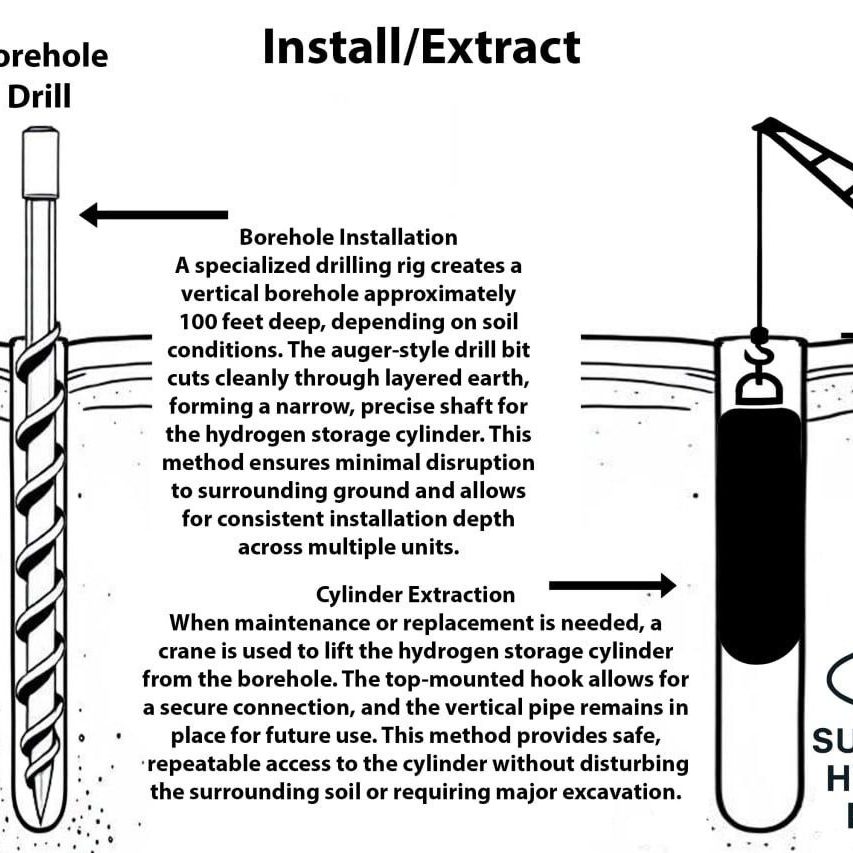
Installation and Extraction: Simple, Safe, and Repeatable
The Subsurface Hydrogen Battery was designed with practicality in mind, ensuring that both installation and long-term maintenance are efficient and low-impact. Installation begins with a specialized auger-style drill, which creates a vertical borehole approximately 100 feet deep. This precise drilling method cuts smoothly through the earth with minimal disruption, forming a stable shaft for the hydrogen storage cylinder. Because the boreholes are uniform in depth and diameter, scaling the system across multiple units becomes straightforward, reliable, and repeatable.
Once the borehole is prepared, the hydrogen storage cylinder is lowered into place using a crane system. The vertical gas pipe remains connected at the surface, providing seamless integration with the broader energy system. The installation process is efficient and minimizes disturbance to surrounding soil, making it suitable for deployment in diverse environments—from rural farmlands to urban energy hubs.
Maintenance and replacement are just as streamlined. If a cylinder ever needs servicing, the crane is used again to safely lift it from the borehole via a top-mounted hook, while the pipeline infrastructure remains intact. This modular approach allows for rapid swapping of cylinders without requiring major excavation or ground disturbance. By combining clean installation with straightforward extraction, the Subsurface Hydrogen Battery ensures safe, consistent, and sustainable energy storage for decades to come.
Puerto Rico Project
Clean power, fresh water, and new jobs — Puerto Rico has the chance to become the first in the world to launch the Subsurface Hydrogen Battery. Click here to see how this pilot project could reshape the island’s future.
Gallery
SHB




Legal Disclaimer
The Subsurface Hydrogen Battery (SHB) System, including all related schematics, designs, and written materials, is the intellectual property of Eugene Allen. All concepts and documentation are protected by time-stamped records and are currently under patent application or provisional patent status.
The information provided on this website is intended solely for educational and informational purposes. Nothing contained herein should be interpreted as a guarantee of commercial performance, safety certification, or regulatory approval. Actual deployment of the SHB system will require proper licensing, environmental review, and compliance with local, state, and federal laws.
No part of the SHB system may be reproduced, manufactured, or distributed without the express written consent of the inventor. Unauthorized use of these designs, whether in whole or in part, may result in legal action. By viewing this page, you acknowledge that this content represents preliminary documentation of an invention in development and not a finalized, publicly licensed technology.